
Baltimore's Own Northern Soul Legends: Bob Brady and the Con Chords
An Interview with Jim Samuel
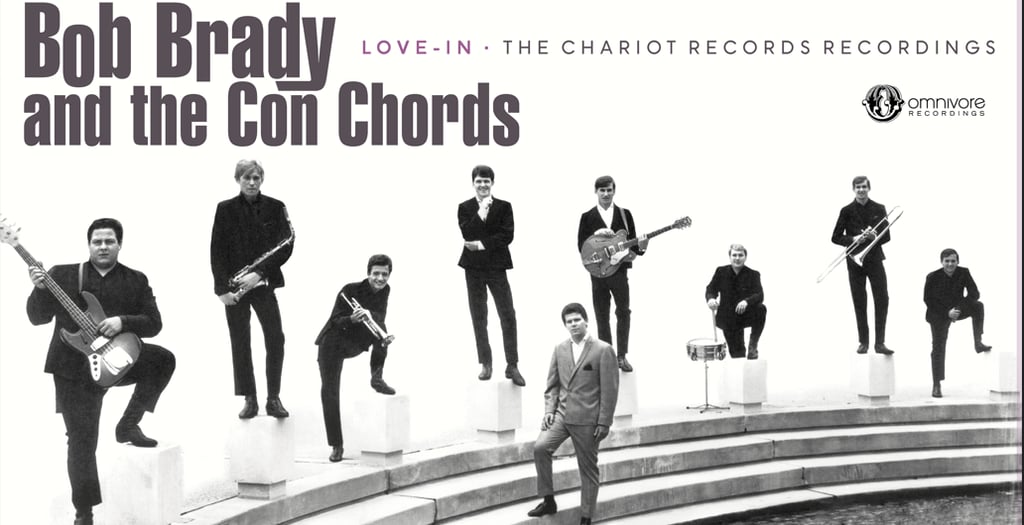
Bob Brady and the Con Chords were one of Baltimore’s most successful and best-loved bands of the 1960s. As a kid, I remember hearing their music blasting from my favorite AM radio station, WCAO. They had several successful singles in the late 1960s and battled for chart position against the major acts of the day. They played throughout the Mid-Atlantic region and their singles were remarkably successful for a band without a major label contract. And thanks to the Northern Soul phenomenon, their recordings are now more popular than ever. I caught up with Con Chords' keyboardist and songwriter Jim Samuel to discuss the Con Chords and their very first recorded compilation LP “Love In” on Omnivore Records.
Jim, it’s great catching up with you. I’m looking forward to hearing the new LP. Omnivore has a great reputation among collectors and music fans. We'd all love to hear the back story. Tell us how and when did the Con Chords form?
Thanks Paul. We formed the Con Chords around 1963. We were originally just a bunch of neighborhood guys who knew each other. I had played in a band (The Navarones) and John Drexler (drums) had played in a band, but this was the first band for many others. Over time, some members stayed while others left. Vince Sansone (bass) heard of the group and joined, bringing a couple of horn players as the group started to develop. The Con Chords simply evolved over time.
Who were the band members and which instruments did they play?
The band members on the original Bob Brady and the Con Chords recordings were Bob Brady (vocals); George Layfield (vocals); John Drexler (drums); Vince Sansone (bass); Tony Constantino (trumpet/drums); Larry Sprigg (trombone); Dave Wladkowski (sax); Ed Bonadio (sax); Jim Samuel (keyboards) and Denny Zwirlein (guitar). John Drexler (drums) and Vince Sansone (bass) left the group and were replaced later by Marty Fisher (drums) and Tom Thompson (bass).
How would you describe the Con Chords’ music?
Our music was mostly a blend of Motown and soul music. In that era, the Con Chords would have been regarded as a “blue-eyed soul” group. Later in Great Britain, the Con Chords would become known as a leading "Northern Soul” group.
When were you recruited into the group and how old were you?
I was one of the original founders of the Con Chords. I was a teenager at the time as were most of the band members.
Bob Brady joined after you in 1964. How did he become a member of the group?
During the early Con Chords years, we had 3-4 lead singers at various times. Bob was looking for a group and met with us. We immediately clicked and the Con Chords found its lead singer. Bob was 5-6 years older than the other band members, which helped our maturity and focus. He also led our efforts in trying more original songs as he really enjoyed the songwriting process.
You and Bob Brady wrote several songs together. What was the songwriting process like?
Bob and I co-wrote most of the original songs of the Con Chords. We often targeted the sounds and styles we thought we could capture, like the Motown/Smokey Robinson style to whom we were often compared. We also drifted to the soul sounds of the era even using the famous Gamble-Huff strings (the Stylistics, the Delphonics) on a couple of songs. The other ideas for songs were often inspired by our managers, Joe Cash and Brent Gordon. They really had a feel for the pulse of the music happening during that time. Because of their music connections, we often had access to some of the big songs and trends before they hit the airwaves. They would point us in a direction they wanted the band to follow and encouraged Bob and me to try to hit the targets they set for us. Bob was primarily lyrics while I was primarily music although we often overlapped and simply collaborated on the songs being written.
Tell us about the group’s first single, “Goodbye Baby” backed with “Tell Me Why,” each co-written by you and Bob Brady and released in 1966.
“Goodbye Baby” was one of the songs inspired by Joe Cash and Brent Gordon. After the Con Chords won Baltimore's Battle of the Bands, Joe and Brent wanted to get us in the recording studio as soon as possible. They started pitching ideas to Bob and me as writers. I remember Joe was particularly interested in "Summer in the City.” This, plus other directional pushes, led us to writing “Goodbye Baby.” “Tell Me Why,” the B-side of the record, was primarily written as a doo-wop, soul song, common in the 60's. The style and harmonies were our focus for this song.
Where were the songs recorded? Did the Con Chords record all of their singles there?
“Goodbye Baby,” our first single, was recorded at Edgewood Studios in Washington, D.C. The song was a local hit and caught the attention of Neil Bogart, president of Cameo-Parkway Records. Neil later became president of Casablanca Records and signed star performers like Kiss and Donna Summers. This led to our signing with Cameo-Parkway for distribution and, thereafter, recording at the Cameo-Parkway Studios in Philadelphia with our engineer being the legendary Joe Tarsia. Tarsia recorded over 150 platinum records with stars like David Bowie, the Stylistics, the O'Jays, Stevie Wonder and the Four Tops. Tarsia later broke off to build and own his own studio, Sigma Sound, where we continued working with him.
Were you pleased with the results of “Goodbye Baby” and the solid local airplay?
For a first attempt, we were very happy with the success of “Goodbye Baby.” Hearing it on the radio was a thrill for this teenage band from Baltimore. The song, thanks to the support of many local radio stations like WCAO and WEBB, climbed into the Top 10 charts for the Baltimore-Washington area. We were excited when we heard that WCAO, the biggest music radio station at that time, was going to make “Goodbye Baby” the pick hit of the month only to have them change their mind and make “Good Vibrations” from the Beach Boys the pick hit. That song was released on the same day as “Goodbye Baby.” At least we got to play with the Beach Boys at a concert at the Baltimore Civic Center. They were really great to us. When we started hearing less of “Goodbye Baby” and more of Diana Ross and the Supremes “Love is Here and Now You're Gone,” about 8 weeks after our release, we knew it was time to begin working on a follow-up song.
Your next 45 release was Smokey Robinson’s “More, More, More of Your Love” backed with “It's A Better World,” co-written by you and Bob Brady. “More, More, More of Your Love” was nestled away as the last track on side two of Smokey Robinson and the Miracles’ 1966 LP, Away We a Go-Go. How did you find this gem of a song and why do you think it was never released as a single by Smokey?
Joe Cash and Brent Gordon, our managers, brought Smokey Robinson's “More, More, More of Your Love” to our attention. Joe and Brent really had their finger on the pulse of the music scene and could predict a hit record better than most. In fact, Joe Cash eventually formed his own company that predicted hits and marketing strategies that the record industry utilized for years. Brent Gordon went on to become an executive with Warner Brothers Records. They knew the strength of the band-our harmonies, a strong horn section and Bob's ability to sound like Smokey Robinson - and knew the Con Chords could come up with a strong version of this song. I am not sure why Smokey didn't release the song with the Miracles. I do know that he told an audience at the Club Venus (where we were guests) that he liked the Con Chords version of the song better than his version. Always a gentleman and a genuinely nice guy.
“More, More, More of Your Love,” released in 1967, was a huge local success that received extensive airplay. Was there a national release?
“More, More, More of your Love,” was a local hit as well as a regional one. In those days, singles for new artists were generally released in regions versus national releases. This was due to the cost of producing records. Our song was released on the East Coast and was a Top 10 record throughout the region launching onto the Billboard Charts despite its limited release. Just as it was about to be released nationally, Cameo-Parkway ceased doing business due to a financial issue. “More, More, More of Your Love” was pulled from distribution. What appeared to be a huge hit about to happen died when the distribution was pulled. About one year later, Bell Records signed the Con Chords and tried to re-release the song but, having lost its momentum, the song failed to climb the charts on this second release. It was re-released, again, in 1972 on A&M Records, but did not fare much better at the time.
1968 brought forth another set of Brady-Samuel songs, “Illusion” backed with “I Love You Baby.” What are your recollections of those songs?
The release of “Illusion” was not a big success, although, to be honest, it was my favorite original Bob Brady and the Con Chords song. I thought it captured the best elements of the group, but the listening public didn’t agree. “I Love You, Baby,” the B-Side was one of the more "pop" sounding songs we recorded.
Perhaps an even bigger hit was your next single in 1968, the Brady–Samuel composition, “Everybody’s Goin’ to the Love-In” backed with “It's Been a Long Time Between Kisses.” How did the song “Love-In” come about?
The funny thing is, “Everybody’s Goin’ to the Love-In” was nearly not written. After the success of “More, More, More of Your Love,” we were given the opportunity to record another Smokey Robinson song, “The Tears of a Clown." Although we had a great version of the song ready to record, Joe and Brent felt it would be better to try and generate an original song that had a Smokey Robinson feel, versus recording another of his songs which might lead the public seeing us as a Smokey cover band versus a group with some originality. This led to Bob and me writing “Everybody's Going to the Love-ln.” The B-Side, “It's Been a Long Time Between Kisses,” was another venture into the more pop side of the Con Chords.
“Everybody’s Goin’ to the Love-In” was a huge regional success. Did “Love-In” fare well outside of the U.S. as well?
Of all the Con Chords songs, “Everybody’s Goin’ to the Love-In” had the broadest success. A regional hit in the States, this record really took off overseas, eventually becoming one of the big hits on the Northern Soul circuit of Great Britain. It also had "legs,” being played for many years on commercials for Kentucky Fried Chicken, on TV shows like Grey's Anatomy, on cable with it having been a theme for an international fashion series produced in Australia and, for many years, being used on English football broadcasts.
What can you tell us about the Northern Soul phenomena and the lasting popularity of the Con Chords’ records?
“Everybody's Going to the Love-In” is all over YouTube and social media. It has played for years on multiple venues and is considered a classic Northern Soul song. The Northern Soul movement began in northern England in the early 1970s. The movement embraces the sounds hard to find, danceable American R&B singles from the ‘60s. The Con Chords’ music fits that bill perfectly. Bob Brady and the Con Chords are often included in the all-time Northern Soul Top 50 groups charts. “More, More, More of Your Love,” became another Northern Soul favorite, and also appeared on European versions of shows like CNN and on Burger King commercials.
It looks as though 1969 saw the release of “It's Love,” a Rascals cover, backed with “Love Is the Master (I'm The Slave)” written by Bob Brady. Do you recall that recording?
Yes, the Rascals’ “It's Love” was the last song I recall recording with the original Con Chords. George sang most of the lead although it was released as a Bob Brady and the Con Chords song. I recently listened to the song as part of the upcoming release of the Bob Brady and the Con Chords album. It sounds better than I remember, a really strong, driving song with a different feel than other Con Chords releases.
At some point in 1969, Pen Lucy split off from the Con Chords. Did you sense a musical change in the wind?
Over time, differences developed over what direction the band should take. Bob and a few others wanted to stay with the Motown/soul feel. I wanted to go in a more jazz/rock direction like Chicago or Blood, Sweat and Tears, while George and Tommy leaned more toward rock and pop. Eventually, George, Denny, Tom, Marty and I split off to form Pen Lucy which became one of the area's top club/show groups, although we did little in way of recoding original songs.
It looks as though Bob Brady continued the Con Chords with new band members. 1969 saw the release of “Savin' All My Love for You” backed with “Please Stay,” both written by Bob Brady. Later in ’69 the group is said to have released a “Paul is Dead” novelty song as the Mystery Tour called “The Ballad of Paul.” (I remember hearing that one on WLPL-FM). Did you have any involvement with those recordings? How about the early ‘70s release “Function at the Junction,” by Energy, said to be a Con Chords - related recording?
No. Those 1969 45s were recorded by the new Con Chords members. And I likewise did not participate on “Function at the Junction.”
Tell us about a few of your most memorable Con Chord gigs.
Bob Brady and the Con Chords played with many famous artists and groups due to our successful records. We played with the Beach Boys, Stevie Wonder, Martha and the Vandellas, JJ Jackson, Ray Charles, Leslie Gore… the list goes on and on. We played on the Merv Griffin Show and, on a few occasions, the Jerry Blavat Show. Jerry had a nationally syndicated TV show with a large following in just about every city but Baltimore. Baltimore had the Buddy Deane Show, a local favorite and the inspiration for the movie Hairspray, which knocked the Blavat show out of that market. On the Jerry Blavat Show, we played with many artists including Freddie Scott, Jeannie C. Reilly and the Orlons. It was a blast doing the show. Jerry wanted the Con Chords to be the house band for his show but, since many of us were teenage college students, we opted out. Blavat loved the Con Chords and his influence helped with the success of our records. Jerry helped re-open the Robin Hood Dell in Philadelphia. This large, outdoor amphitheater used to feature artists like Count Basie and Frank Sinatra in the ‘40's but was closed for several years. Jerry helped it re-open to concerts and the Con Chords were part of that re- opening concert in 1967 along with Patti Labelle and the Blue Bells, the Tokens the Soul Survivors, Peaches and Herb, Gene Chandler, Jay and the Technics… about a dozen acts performed that night. Robin Hood Dell had about 4500 seats but sold lawn tickets as it was an outdoor amphitheater. 19,000 tickets were sold for that night and it was recently reported in a newspaper article that over 30,000 viewed the concert, as the hillsides outside of the Dell were filled as far as one could see. This was clearly one of the vivid memories of the Con Chords years. We got a chance to play the Dell again a year later with help from Jerry Blavat. Another concert with some groups returning and new artists performing for a large crowd. A special time for Bob Brady and the Con Chords.
Tell us about the reissue project by Omnivore Records.
Omnivore Records is the most successful retro music company out there. Owned by former execs with Warner Brother Records, Omnivore felt there was a market for a Bob Brady and the Con Chords album (we only released singles, never an album) not only in the states but also internationally due to their Northern Soul reputation. With the new wave of vinyl record releases, Omnivore believed an LP release on Record Store Day (April 18, 2026), the biggest day of the year for vinyl record sales, would be the best way to release its Bob Brady and the Con Chords album. The collection is called Love-In: The Chariot Records Recordings. It contains all of the group’s A & B sides released from 1966–1969, plus a track called “I Stand Rejected,” written by Bob and released as the B-side of the 1972 re-release of “More, More, More of Your Love” on A&M Records. The LP will be released on Record Store Day in all 50 states and 43 countries. It will also be available in digital download format on April 24th.
Thanks and best of luck with the LP, Jim!